
Topeka Previous-Resident Evidence
A sound address history starts with the period being studied. Shawnee County land records establish ownership from the territorial era forward. The city directory shelf can place people at an address, including some who never held title. Maps and permits add facts about the structure itself. Census, probate, and obituary records supply household and family context. No single row proves continuous occupancy.
| Evidence source | Verified span | Local keeper | Useful result |
|---|---|---|---|
| Deed books and indexes | Books 1855-1927; indexes 1856-1901; county records 1856-present | Register, KSHS, FamilySearch | Legal owners and transfers |
| ARES and parcel GIS | Current roll; updated 08/23/2026 | County Appraiser | Owner, address, IDs, legal description |
| City directories | TSCPL 1870-present; KSHS 1868 onward | TSCPL, KSHS, TGS | Dated household or business presence |
| Building permits | Index 1880-1925; current Cityworks view | KSHS and Topeka Planning | Work and construction dates |
| Sanborn maps | 1883, 1885, 1889, 1896, 1913; later runs | KU and TSCPL | Footprint, lot, use, street clues |
| Census and family records | Territorial 1855-59; state 1865-1925; federal through 1950 | Archives and library databases | Household snapshots |
For a recent transfer, start with the parcel and deed index. For a past resident between census years, begin with a directory entry and test it against title, newspapers, and probate. The full holdings are described on the Topeka city directory page.
Start a Topeka Address Trail
The Shawnee County ARES search accepts an address, owner name, QuickRef, parcel ID, subdivision, or an unfiltered query. Save the physical PADDRESS, owner display, QuickRef or PID, legal description, subdivision, and DBOOKPAGE. Note the date searched. Assessment data changes, and tax and valuation fields may update at different times.
Do not merge the situs address with MAILADDRESS. The first is the parcel location. The second is where owner or tax mail goes, which may be another city or may name an estate, trust, or agent. That split is a useful local quirk, but neither field names every occupant. The legal description carries the same land across a changed street name or number. Current research can continue through the Topeka street records workflow when the question expands beyond one parcel.
Walk Shawnee County Deeds Backward
The Shawnee County Register of Deeds preserves deeds, mortgages, plats, surveys, easements, affidavits, releases, and other land records. Its channels matter because online access is not the only path.
- Copy the parcel IDs, legal description, and deed reference from ARES or GIS.
- Search the present owner or deed placement in the grantor-grantee index.
- Open or order the deed. Record dates, parties, legal wording, prior reference, and estate language.
- Search the prior grantee and cited book/page, repeating while the land description agrees.
- When online access stops, use office books, KSHS film, FamilySearch images, or a TGS abstract.
- Chain of title
- The linked sequence of recorded transfers for the same land.
- Grantor and grantee
- The party giving an interest and the party receiving it.
- Legal description
- Lot, block, subdivision, or boundary wording that identifies land despite street changes.
The official access-options page documents free public computers, Tapestry at $8.95 per search, and Laredo subscriptions. Staff explain the index but do not perform a title search.
The county’s deed choices are visible here:
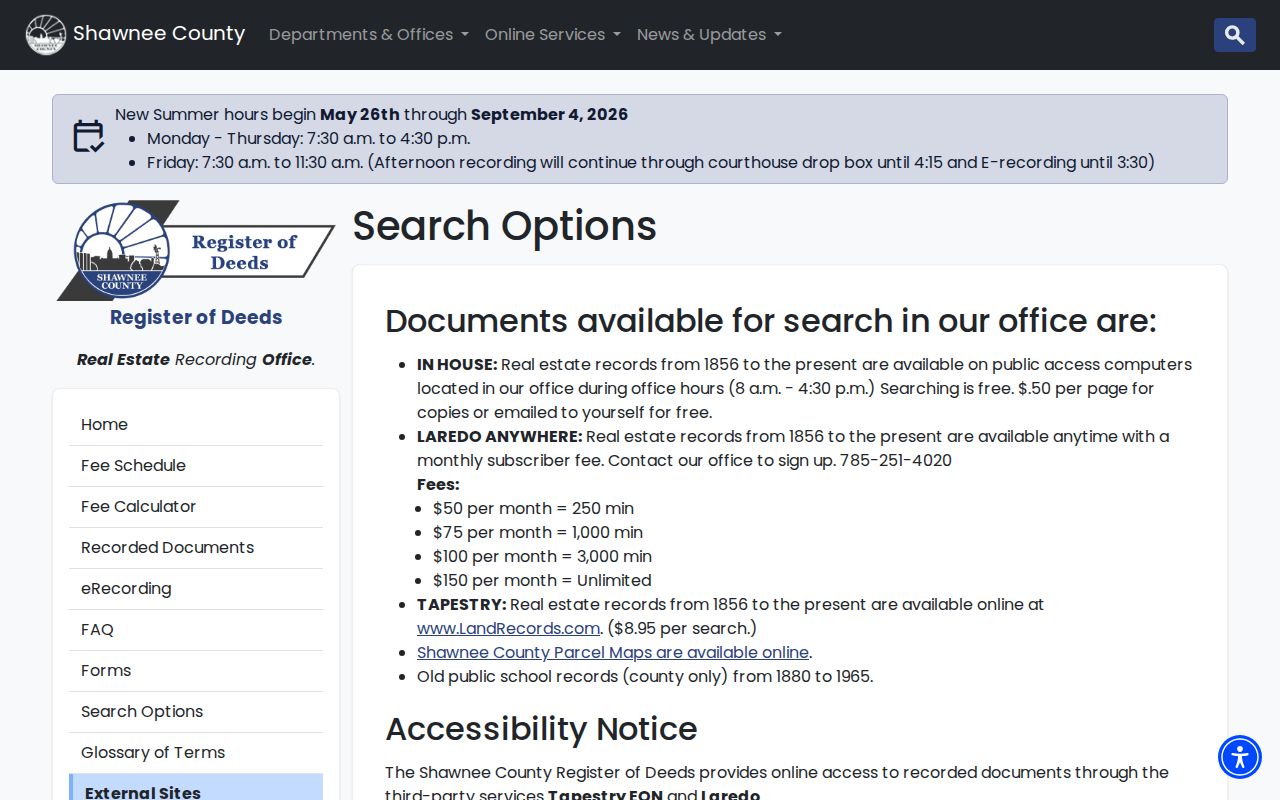
The source lets a researcher choose counter, paid online, or subscription access instead of treating one failed query as a missing deed.
Topeka Records Reach Territorial Years
The local recorder story begins before statehood. The Territorial Assembly created a Recorder’s Office in 1855, and the title changed to Register of Deeds in 1858. County real-estate records are described as 1856-present. That span lets a trail move from a modern parcel into handwritten books and filmed indexes.
The Register’s official page shows the custodian and access setting:
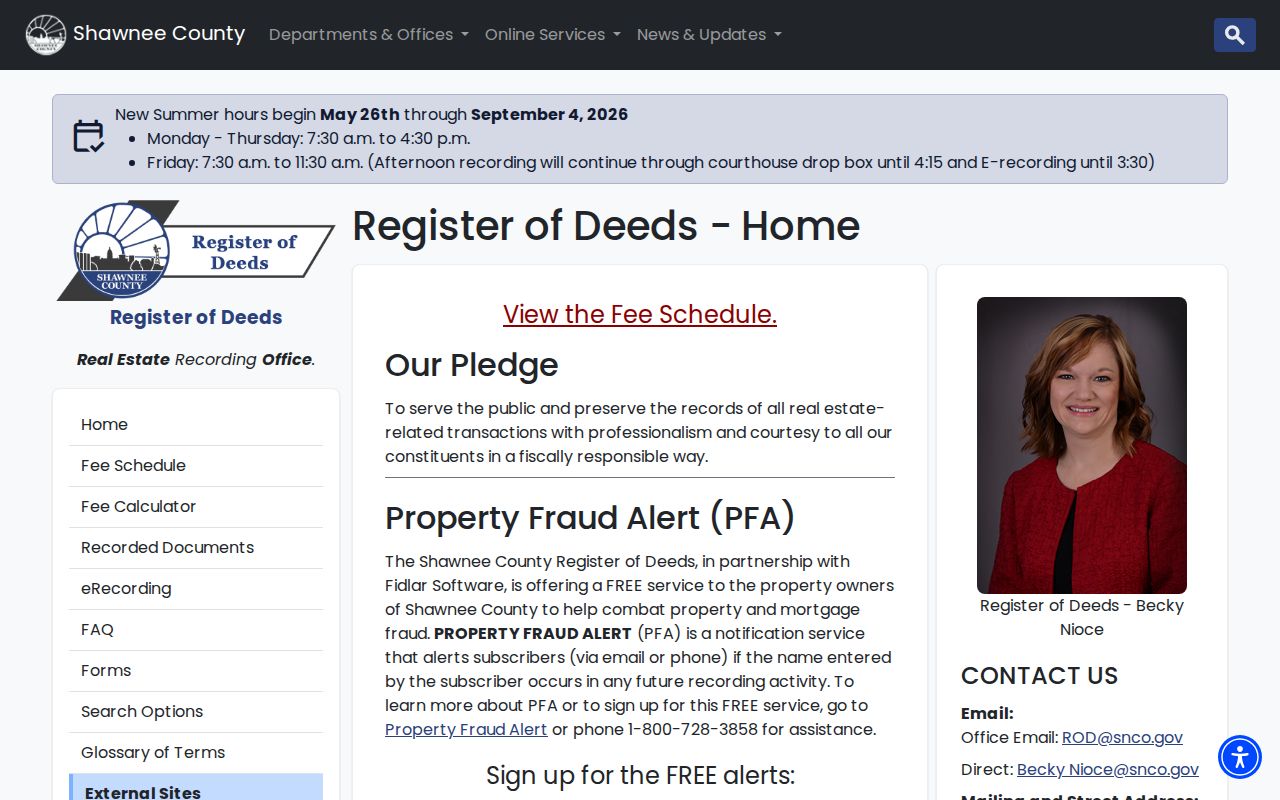
For May 26 through September 4, 2026, posted hours are Monday through Thursday, 7:30 a.m. to 4:30 p.m., and Friday, 7:30 to 11:30 a.m. Verify the notice before visiting Room 108 at 200 SE 7th Street.
Tapestry EON provides the paid online path:

Its result is an index and image route, not proof that the named party occupied the property. Preserve the official reference for the next step.
Bridge Early Topeka Deed Gaps
TGS identifies KSHS deed-index rolls AR3888-3893 and AR4060, plus deed-book rolls AR3704-3883 and AR4059. FamilySearch holds browsable images in the Kansas, Shawnee, Land and Property catalog path, though books are generally not name indexed. Keep book and page from each result so those images can be reached directly.
More than 800 Columbian Title Company abstract volumes held by TGS may bridge a missing link. An abstract can preserve earlier owners, relationships, locations, and several references. It is a finding aid, not a deed substitute. Compare each note with the recorded instrument before adding a name to a list of previous residents.
Note: A no-result does not prove absence; retry initials, married names, estates, spouse names, subdivision terms, and the exact legal description.
Match Topeka Past Households
Ownership is only half of address history. A directory can place a householder, spouse, renter, or business at an address on its publication date. Census schedules add ages and relationships. Obituaries, cemetery files, and probate may explain a death, inheritance, or move.
- Choose directory issues on both sides of a deed or permit date.
- Record the printed address, including quadrant, abbreviation, and cross street.
- Compare the closest state or federal census schedule.
- Test names against TSCPL obituary, TGS probate, cemetery, or funeral indexes.
- Label each entry as title, directory presence, permit work, or family evidence.
A parcel owner may mail elsewhere, and an annual directory may lag a move. Two independent, dated layers provide a safer basis for stating who lived here before.
Lawful use. Research past residents for house history, genealogy, heirs, or personal curiosity. Never use an address trail to track, harass, or expose a living person.
Use Topeka House-History Files
The Topeka and Shawnee County Public Library resources join the HOUSES vertical file, hardbound directories, maps, blueprints, newspapers, obituary access, and Sanborn material. A librarian and ScanPro reader help when a clue is held only on film or a shelf.
The library route appears here:
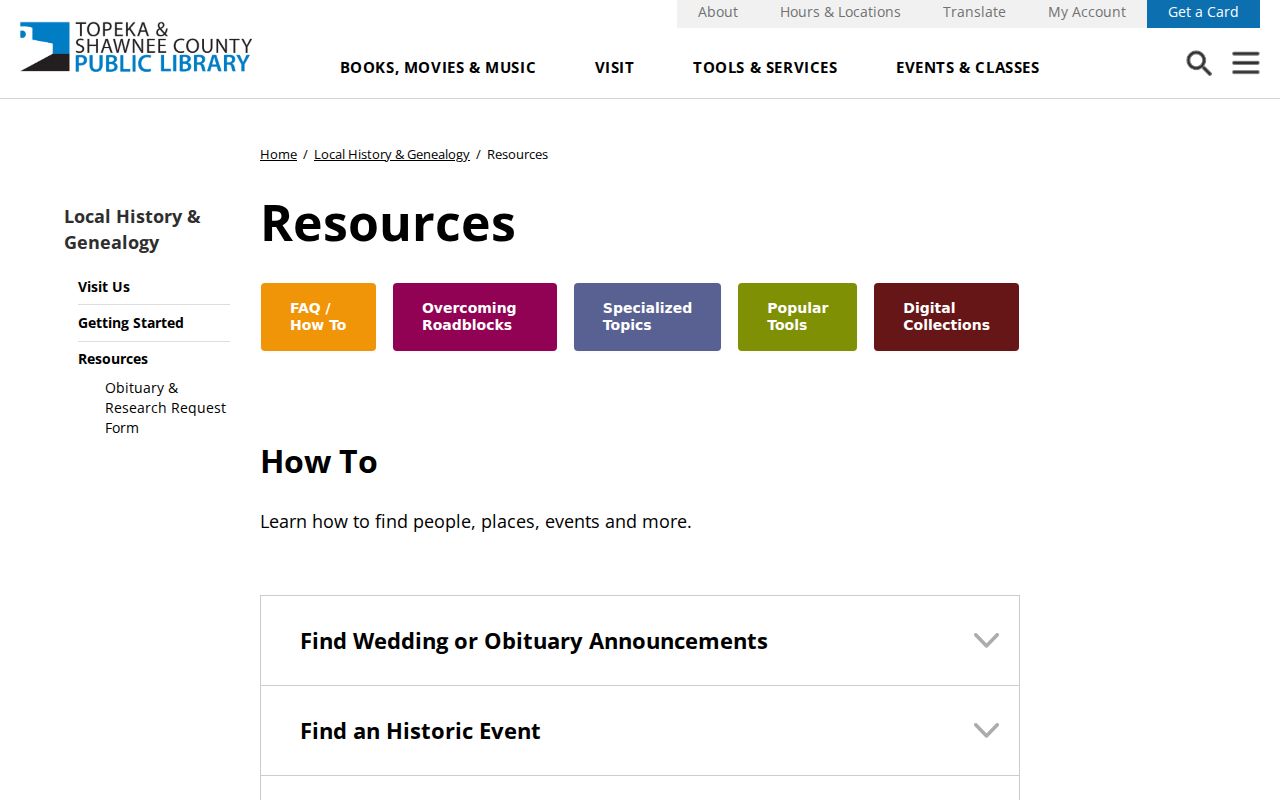
The collection can link a transfer to a clipping, blueprint, map, or directory address. Appointments are available through the genealogy service. In-library databases are not unrestricted remote indexes.
Repair Topeka's 1937 Address Break
TGS documents Topeka street-name changes made in 1937. A valid old address may seem to vanish. Preserve the former name, directional prefix, number, and cross streets. Compare the subdivision, lot and block, Sanborn footprint, and legal description with the current parcel.
Sanborn maps for 1883, 1885, 1889, 1896, and 1913 are available through KU, while TSCPL has later printed runs. Maps show a structure’s outline, use, and lot context, not every resident. The 1880-1925 permit index and current Cityworks view add work dates, but a permit applicant is not automatically an occupant.
A Rare Topeka Ownership Cross-Check
The 1913 Shawnee County atlas offers an unusual check. Township maps carry landowner labels, while pages 41 through 44 include an automobile-owner directory with owner name, address, make, and year. A match can tie a map, person, and dated address together.
Treat the atlas as a snapshot. Search the same person in a nearby directory, then compare a deed, newspaper, or probate record. An atlas label or vehicle entry cannot prove full-year residence. That narrow use keeps the timeline clear about what each source shows.
A past-resident ledger should preserve both what was found and what remains uncertain. Record the modern address, old printed address, parcel ID, deed book and page, event date, named parties, source location, and the exact type of evidence. If an estate, executor, trust, or attorney-in-fact appears, retain that wording. It can explain why ownership changes even though no conventional sale appears. A mortgage release may confirm timing but does not transfer title. A plat or survey may change the land description while the house number stays much the same.
The question of where a seller went next requires a separate search. The deed proves that the seller transferred this parcel, not a new home address. Later directories, obituaries, probate files, and another deed can support a move only when a date, spouse, age, or other identity point agrees. Utility hookups were not verified as a public historical resident source in the inspected Topeka material, so use permits, directory issues, maps, newspapers, tax records, or recorded deeds instead.